One citizen’s struggle against illegal construction in post-conflict Kosovo

Meet Valdet Osmani, President of the Architect Association in Kosovo.

The current construction boom is resulting in over-crowded and sub-standard living areas all over Pristina. Developers’ greed and institutions’ inability to enforce construction regulations are the main causes.  Valdet Osmani, President of the Architect Association, is taking on the Kosovo capital’s ghettofication, before it’s too late.

“We are building a city without consideration for people’s health, safety and well-being”, exclaims Valdet Osmani, 39, and asks rhetorically  “Is this how we like our children to grow up – without sunlight, sidewalks and green areas?’ He speaks passionately about the Architect Association’s advocacy work against illegal construction and the destruction of the urban landscape in Kosovo.  “It’s a human rights issue, each citizen has the right to healthy and safe living. But this is hardly what the developers are offering today”. With two children of his own, Osmani feels the urgency of reversing the negative trend that is characterising reconstruction and construction in Kosovo.

Valdet is fervent when he speaks about architecture and urban planning. “Architecture is the representation of a country and its civilization. My vision is to understand history, analyse the present, and develop sustainable living solutions for all people”, Osmani proclaims. Raised in Mitrovica, Osmani moved to Pristina to pursue a university education in engineering and architecture. He then worked on international donor reconstruction initiatives for housing, hospital and infrastructure development.

This period was a real eye-opener for the young Osmani. In dealing with municipal authorities it became clear that a too restrictive response to construction permits resulted in a boom in illegal construction and perversely enough, less problems with the local authorities.

This was in 2002 and the first time Osmani raised his voice, requesting the municipal authorities to place a moratorium on construction activities in some neighbourhoods and provide regulations for not yet developed lands, encouraging investors to apply for permits.

Lashing out at Osmani, the local authority told him, “you are too young to advise us on city development”. “This was the game changer for me”, recalls Osmani. “I knew I had to get involved in the public debate about construction. I knew we had to do more ourselves, as Kosovars, to change our development path away from corruption. Illegal construction had become a way of doing ‘business’ for both municipality authorities and private construction companies. We were losing our common future. That’s why I joined others with the same motivation and drive, and established the Architect Association”, explains Valdet.

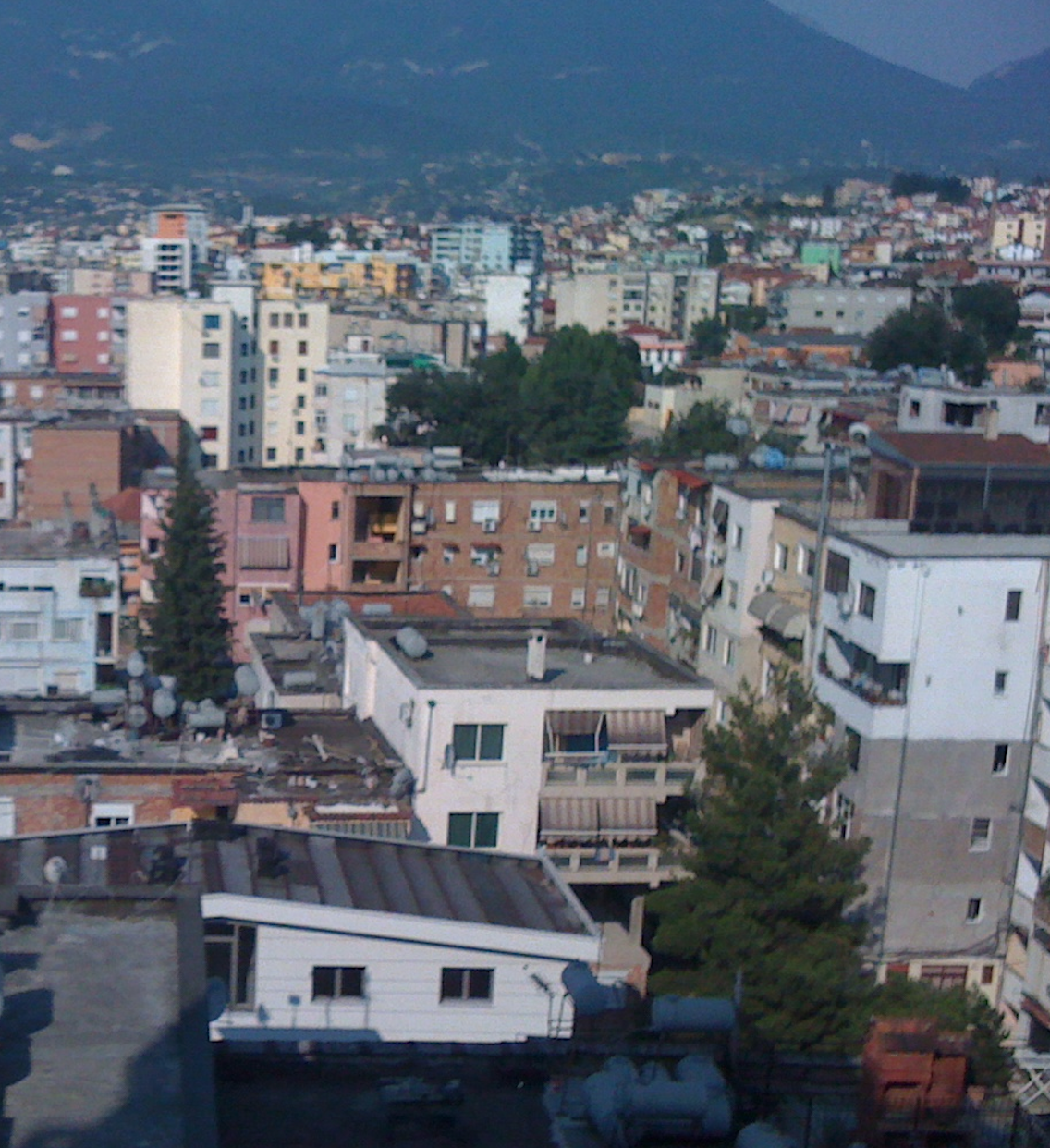
The Dodona neighbourhood, in the centre of capital Pristina, was once an oasis of one-family houses and greenery. “No more than 100 people lived here back then”, Osmani explains and points to the narrow street, “and now these non-proportional, enormous apartment blocks will host at least 2000 residents and 500 cars will try to find parking here every day.” The lack of functionality is striking. 

Osmani continues to explain the physical and psychological health risks associated with over-crowded living areas. “It’s very stressful to live here. Think about it. You invest your savings in an apartment to get away from your parents or the village. You may even take a bank mortgage. But then you discover you can’t let your kids outside because of the traffic, your apartment gets no sunlight, it’s dusty, sewage doesn’t function properly and it stinks all summer. On top of that you have to carry the house waste 300 meters to the nearest garbage bin. And you will never be able to sell. You are stuck”, Osmani bellows, shaking his head in disbelief.

“This is how ghettos start”, Osmani reiterates. “Spatial planning and construction standards are systematically abused.  Laws and standards are not enforced. Inspections don’t lead to penalties, but to more corruption. The municipality adds to the misery by not ensuring adequate public services, such as kindergartens and health centers.” At some point in the future people will move out, leaving behind pockets in society with limited financial means. In turn, as fewer and poorer residents are left behind the properties will start to decay and even less public services will be provided. “It’s a vicious circle of irresponsibility, which will lead to the ghettofication of certain parts of the city”, concludes Osmani.

To Osmani the negative outcome of the current construction boom is symbolic for a state that is failing on its obligations to citizens. “The politicians in Kosovo love to talk about EU integration, but this process means adopting and applying EU rules, norms and values that uphold a functioning state, ensuring a higher quality of life and more liveable cities. Until now, we have been incapable of producing either”.

Osmani has experienced a series of failures in trying to stop illegal construction. “As citizens, we are equally to blame for the mess we find ourselves in. We failed terribly in neighbourhoods such as Peyton and Arberia. The people there were unable to organise themselves, they were very pessimistic and they did not believe us when we told them that they have rights and we will support them. The municipality authorities, on the other hand, were too weak and did not provide any regulatory plans for the neighbourhoods, leaving the field open for uncontrolled and over-dimensioned construction”, admits Osmani.

The success of the association in stopping illegal construction has so far been limited to minor violations, such as spontaneous balconies and small building expansions in Ulpiana and Sunny Hill. In these cases, the municipality has reacted. “But we are filtering mosquitos and letting through the elephants”, exclaims Osmani. “In order to stop the larger violations, those that ruin entire neighbourhoods, forever, citizens must join together as they did in Istanbul and demand a stop to illegal construction.

As an association of architects, we can support such citizens’ initiative, but we cannot drive the cause, that’s the job of the people, and that’s their right within a democratic society”, proclaims Osmani with mixed feelings about the future. “In Mitrovica, we succeeded in stopping the construction of a restaurant in the green area of the town”, Osmani remembers, again sounding more optimistic about what can be achieved when motivated citizens join forces and take common action.

“Then there are those few developers, who we have managed to convert from illegal to legal construction”, Osmani informs with some satisfaction, “I cannot disclose their names, because they don’t want to admit any past illegalities, but the buildings included both residential and commercial activities. The main reason they turned legal was to avoid future problems with the law and not to risk their investments, minimize the corruption exposure and official threats for demolition”, explains Osmani.

“Have a look at this sketch”, Osmani continues, “this is what any street in Dodona or Peyton neighbourhoods should have looked like, had construction laws, standards and rules been followed”. The differences between theory and practice could not be more striking. Despite all laws and regulations claiming to protect them, trees and sidewalks have been swallowed up by abnormally large concrete structures, built too close to the street. “It could have been a wonderful place to live, full of air, light and space to walk, even for children and old people”, asserts Osmani with obvious frustration in his voice.

graph street

The continuous frustrations in working with irresponsible authorities and greedy developers, the many lost struggles and few victories have shaped Osmani’s character. “He is more direct in his language now, sometimes very direct in calling for rule of law and professional competence, especially when dealing with incompetent civil servants. He presents facts and truths in face to face discussions, which some may perceive as a too personal of an approach. But it’s all too personal in the Balkans, you know, we have problem dealing with each other as professionals”, describes Bujar Prestreshi, a close architect colleague to Osmani.

In Pristina, the association estimates that 50.000 housing and commercial units are constructed illegally and 80% have no occupancy permits. The legalization process is extremely slow. “But we cannot put all blame on under-paid civil servants. As professionals we have to uphold some kind of professional standards ourselves”, admits Osmani. In response, the association is proposing a licensing process for architects and is drafting planning and construction rules for architects to respect. “We may not be able to change the current situation, for some streets it’s simply too late. But we must strive to save the future”, concludes Osmani philosophically, “We owe it to our children, otherwise we are bound to lose them to emigration”.

Osmani speaks from personal experience. “Brain drain is a serious threat to our hope of building a normal European state and society”, tells Osmani, highlighting that in recent months two well-educated friends have left for Canada with their families, and others are working hard to follow suit. “They will never be back, the brain-drain will continue , unless we make away with our corrupt practices and give normal, hard-working people a chance to succeed”, he concludes disappointedly.

Osmani treasures his time with family and friends, but even away from the daily struggles of the Architect Association he tries to contribute to society. “We are a shrinking group of friends that take time every other Sunday to clean up litter in Germia park.” In a period of intense individual wealth accumulation, fundamental ideals such as community development and volunteerism are on the back-heels in Kosovo.

“We could all do so much more as individuals, as citizens”, reiterates Osmani, “simple things like throwing litter in the bin and not park the car on the sidewalk. As citizens, we have responsibilities, not only individual rights.” But as long as a few individuals’ rights are perceived as more valuable than others, then elitism, favoritism and nepotism will continue to flourish and destroy human rights, community values and turn neighbourhoods into ghettos. The children of Kosovo will not be happy about that.
Posted in Uncategorized | Tagged , , | Leave a comment

Hats off to Pristina’s unseen heroes – the Garbage collectors

We may not give them much thought. In fact, we may resent them as their truck blocks the road for a minute or two. They are the city garbage collectors, and looking at the amount of garbage we produce and they collect, well, I think at least, they deserve our gratitude.

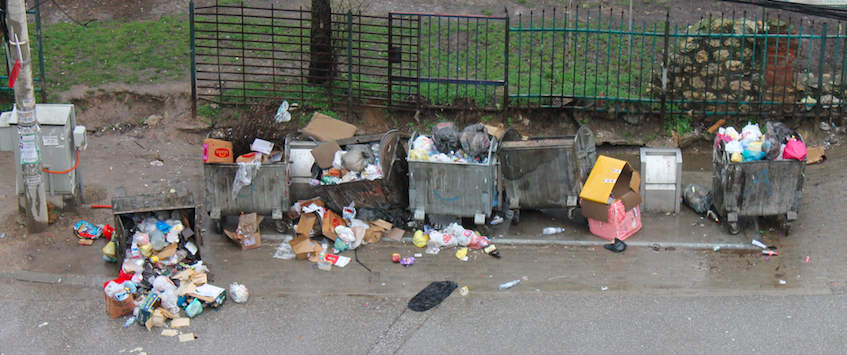
There are eight large garbage containers located across the street from my apartment block. The containers are emptied three times per day, weekdays as well as weekends. Yet, the containers are always full and sometimes the waste overflows into the street.

park bins

These few containers serve our entire neighborhood. The number of bins was probably adequate once, when the neighborhood was made up of a dozen one-family houses. But now, hundreds of households have been added, and with them tons of more waste, as a result of excessive construction.

The same way nobody appears to have foreseen the increased influx of cars, demanding parking spaces, as a result of rapid urbanisation, the increased demand for garbage containers appears to have caught the urban planners by complete surprise.

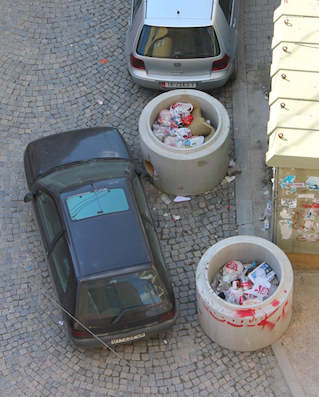
Garbage trucks can no longer enter the crowded, narrow streets, forcing the inhabitants to carry their household waste to these eight precious bins. Some even use their fancy cars to transport garbage. There is just something about quality of life that’s gone missing here. Or people create new bins out of concrete sewage pipes or drop the bags around the corner, hoping for somebody else to deal with them.

Spontanuous bin 1

Back at the bins, household waste is topped up with construction materials, cloths, old furniture and the occasional broken toilet seat. No recycling here. Except for the occasional poor person plowing through the plastic bags in search of cans and tins. Food and bread, still deemed ok to eat, are left for the poor in plastic bags hanging on the side of the bins. Poverty has a real face in Kosovo, if you just care to have a look around.

According to a report of World Health Organization (WHO) an estimated 7% of the people in Kosovo are disabled, putting them in the group of least employable persons. About 37% of the population lives in poverty (less than €1.42/day) and over 17% lives in extreme poverty (below €0.93/day) according to the UNDP Kosovo Human Development Report 2012.

Most recently, a butcher shop must have decided to drop off the leftovers of butchered cows and goats, to the delight of the local dogs, and crows. Every two weeks a small digger cleans up the heavy garbage left beside the bins. Disinfection powder is sprayed all around to stop the spread of disease. It’s an impressive show of public services being applied in a professional manner.

However, as Pristina grows it is difficult to see how the garbage situation will improve without significant investments in its waste treatment infrastructure, and changes in our own practical approach to ‘reduce, reuse and recycle’. There is also a need for a proper recycling center to handle all the non-household waste. At the moment, it all ends up in the bins across the street…out of the sphere of our personal interests and care?

Posted in Uncategorized | Tagged , , , | Leave a comment

Exploring ‘Parkut të Qytetit’, Pristina’s forgotten park

Anyone living in Pristina will know that walking in the city is risky business. Cars parked on the sidewalks forces pedestrians into the streets, where we are at the mercy of some unpredictable driving habits. We escape to Germia park for tranquillity, but Germia often feels too far away. Luckily Germia is not the only park in town.

IMG_2930

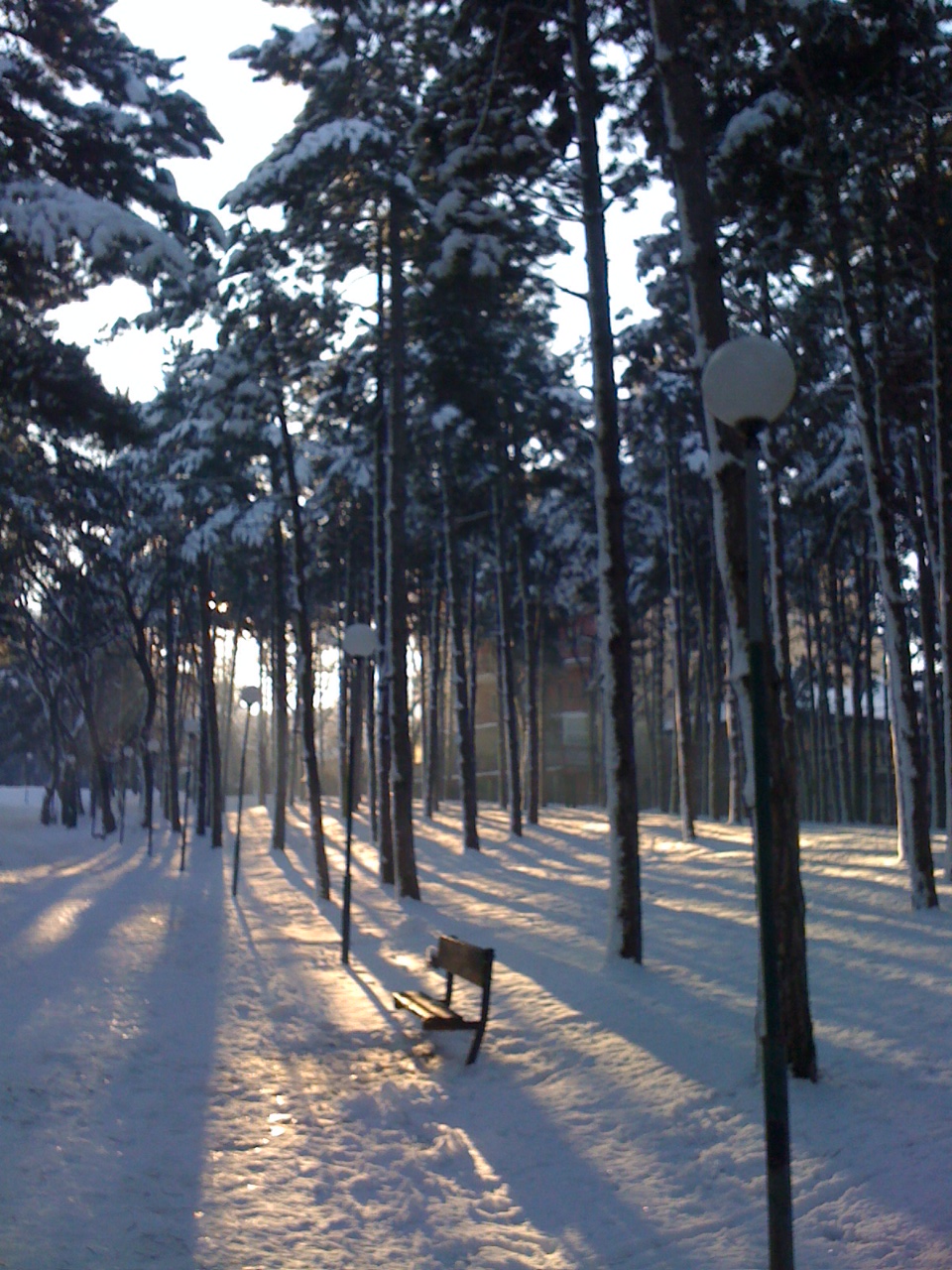
‘Parkut të Qytetit’, central park in Albanian, is the only mature green area left in the heart of Pristina. During the 1999 war, the local population desperately needed wood to heat their houses, yet the park’s tall pine trees were surprisingly spared the axe. “We just love our park, it’s small, but we love it all the same. I walk here with my friends every morning”, exclaims Ardita, an energetic pensioner with a warm smile.

In post-conflict Kosovo, the Italian government financed the initial restoration of the park, laying new stone paths, ensuring lightening and building playgrounds. The locals nicknamed it the ‘Italian park’. Calling it ‘City park’ became popular for a while but with the construction of ‘City Park’ shopping mall, people returned to using its proper name – ‘Parkut të Qytetit’.

Parkut të Qytetit is easily reached by walking up Tringë Smajli street, crossing Agim Ramadani and later Gustav Meyer, before entering through the main gate on Hamëz Jashari street. The park is a waterhole for all generations. While Ardita and her generation of walkers move on to drink tea at one of the park’s three cafés, teenage lovers, kindergarten groups and families replace them.

IMG_2935

“The park is the only free place in town where we can be alone”, explains a young couple (who would rather remain anonymous) half-laying against a maple tree, “at home we have no privacy with mother and grandmother around.” Down at the playground, the kids are filling in fast. The around-the-clock wear and tear by Pristina’s younger citizens has left the swings, slides and climbing bars in a sorrow state. But the decaying playground does not stop the children from enjoying themselves to the fullest. Their loud, happy laughter reminds you of a public beach in July.

The park is surprisingly well maintained and clean. “We do our best”, proclaims Ermir, a fast-moving member of the park maintenance team, “but I wish the young people would throw their litter in the bins instead of all over the park”. Like Sisyphus, Ermir will be back roaming the park tomorrow, emphatically filling his large bag with coke bottles, chips bags and snack wraps, some thrown just meters away from the park’s many litter bins.

Colourful flowers are planted every spring along the park’s main alleys, and watered throughout the hot summer.  The green lawns are cut regularly, welcoming the next generation of Kosovo football stars. The municipality is currently constructing a new basketball court. “It will be great to play on a court where the hop actually has a net”, concludes Gazmend, a tall teenager, and laughs wholeheartedly.

Park gate in snow_23 October_2014

On winter days like today, the paths of Parkut të Qytetit turn into icy luge half-pipes. The gentle slopes carry the children’s sleighs through the forest to the very bottom up the park. Halfway down, the ‘Rona’ restaurant offers hot chocolate in front of an open fire, warming up both feet and soul, while you look out into a snow-covered forest. At such a moment, the Parkut të Qytetit feels more like the Brezovica ski resort than downtown Pristina.

photo

Posted in Uncategorized | Tagged , , , | Leave a comment

Demonstrating for ‘normality and peace of mind’

The demonstrations have been going on for more than 6 months in Bulgaria now. Every day the crowd of anger gathers in front of the parliament building, calling for the Government to resign on grounds of favoring domestic oligarchs, and its incompetence and greed. Bulgaria is a EU member state since 2007, yet a large portion of society feels the country has no future. The well educated and motivated have already left or are thinking of leaving the country. Few of them will return.

A similar sentiment is currently felt on the streets of Kiev. Ukraine, a country severely split in its aspiration for EU membership. Unable to break free and improve the socio-economic situation at home, closer relations with the EU (i.e. visa-free travel) will act as an escape rout to normality for millions of young Ukrainians.

But as the political collapse in Bulgaria clearly illustrates, membership in the EU is no fix-all pill of medicine, and no guarantee for upholding even the most sacred principles of democracy. EU membership does not automatically mean that transparency in public procurement will be upheld, that the most qualified candidate will get the job in public administration, that official racketeering and corruptive practices will decline. EU membership does not guarantee economic growth and prosperity, social equality and social inclusion for the population.

Rather, EU membership offers opportunities to achieve all of the above, but its up to the local political elite and the population to implement and enforce it all. This is just not happening, and that’s one reason why people in Bulgaria are back in the streets demonstrating. On a more personal level, the young and old are on the streets voicing their despair, because of a million personal reasons, because they are tired of:

  • Political parties being driven by corrupt practices and rent-seeking, rather than policies (who is to the left, who is to the right? – nobody knows, we are in it for the power, and to get rich!);
  • Bad (some even criminal) people paying to political parties for a seat in parliament;
  • Paying to get operated, to get promoted, to get a job, to get the necessary documents through an inflated public administration and even paying the football coach to get your kid to play…the list goes on and on…

In the Balkans, and in many other regions of the world with Banana-Republic tendencies and characteristics, the existing political elite is the eternal enemy of the middle-class, and vice versa. It’s a fight with long historical roots, and one that is still at hand for this generation to win. But it’s a zero-sum game, and the odds are against the middle-class to win.

As the backbone of all prosperous states we find a healthy and content middle-class made up averages and free of extremes. The middle-class stands for and seeks transparency, democracy, equal opportunities and equality under the law, where rules apply to everybody no matter wealth and political clout. The middle-class represents normality and sense of predictability for the future. This is what the people in Sofia and Kiev is striving for these days. They don’t expect a revolution, just a peace of mind and a chance to lead a better life.

But, this is not what most political elites want. They may say they do, but their actions speak differently. They prefer secret back-room dealings and decision-making that profit the few. For them the democratic process is a nuisance and undesired risk moment. They promote control and obedience, not competition and freethinking. The role of the media is propaganda, not to discuss policy and God forbid to apply investigative journalism. The political elite supports a society based on favoritism, where the state is seen as a cow for them to milk at will. The rights of the citizens and the hope for future generations are constantly offended. No wonder the frustration is running high among ordinary people.

There are four kind of people left behind in these ‘failing societies’. Those too old to leave the country, those to ignorant to care, those thinking of leaving and the few that reap the benefits of a state not delivering on its obligations to its citizens.

But as the representatives of the middle-class, a class that has never existed, and on this path will never exist in these countries, when they all leave, then the small political elite has won! Leaving behind the old, poor and ignorant, we have capitulated as it was done so many times before in history, and we have given the political elite the ideal group of easily manipulated voters to convince come the next election!

Posted in Uncategorized | Tagged , , , , , | Leave a comment

My Four Favourite Balkan proverbs

During my 20 years in the Balkans I have found that there are some proverbs that transcend borders and time. Here are my four favourite proverbs, which have helped me at least try to understand why people do what they do and say what they say.

1. The Donkey

One day the poor farmer’s donkey dies. The animal meant everything to the village farmer. The donkey helped the farmer pull the heavy load of subsistence farming. Without the donkey, the farmer was going to suffer. The same night a fairy awakes the farmer and grants him one wish. The farmer thinks for a short while, then cries out “I wish my neighbour’s donkey dies!”

There is an implicit strive to create a situation of equality among people in the wish of the poor village farmer. But why equally ‘miserable’ and not equally well-off? Herein lay the mystery.

Perhaps it is the region’s heavy history, the long domination by foreign powers and waves of authoritarian systems that have effectively sucked the positive, creative and pro-active energy out of generations and left this taste for fatalism. With both donkeys dead, the two farmers can suffer together, they will be bound together by their mutual misfortune…they are equal!

2. Small Devils, Big Devil and Balkan ‘cooperation’

In hell, each nationality is placed into an individual burning pot, guarded by a Small Devil. The role of the Small Devil is to push anybody trying to escape, back into the pot. This morning the Big Devil makes his inspection round, and finds the Small Devil in charge of the Bulgarians (replace at will) sleeping at his post. Furious the Big Devil wakes up the Small Devil, fearing that the Bulgarians have escaped from the pot. The Small Devil smiles, tells the Big Devil not to worry and explains that “there is no work for me here, as soon as one Bulgarian gets his hand on the pot’s edge the others pull him down!”

This goes far beyond individual jealousy. This is about stopping those that strive for a better life. This phenomenon is something that goes through Balkan history like a red thread. We can work together, but it’s more likely that we do so to destroy something than to create something. To destroy something is a relatively easy task, which is also easy to sell in to a larger group of people. To construct something, on the other hand, such as a building, a company, an economy or even a nation state, well that is significantly more complicated and will require not only the right technical skills and know how but plenty of will power, organisation, management, collaboration among people and institution as well as civility.

3. The Power of Power

“To reveal the true character of a person, give him power”

Perhaps it’s a result of hundreds of years of Ottoman and Communist rule, but ‘power’ clearly means different things depending on if you are ‘in power’ or not.

In our time, you see this phenomenon most obvious in the behaviours of new political elite. While out of power, the politicians call for the basic principles of Western democracy to be introduced into their backwater political systems, such as transparency, separation of powers and equality under the law. However, as soon as they assume power, they quickly fall back into a more traditional leadership role based on rent seeking, bribery and official extortion of private companies, media and opposition. All in the name of the… (no, not the people), but the few people who enjoy the same tap of public money.

4. Who’s to blame?

“It’s the one that gives that is to blame, not the one that takes

Imagine a region where the absolute majority of the population is very poor (or at least that’s the story they tell, everything is relative). If you then give something to them, be it food, housing or social benefits, then this must mean, in the eyes of this large ‘poor’ majority, that you are rich, and as a person, perceived by others to be rich, well, it’s your obligation to give, without the receiver feeling obliged to hand you any gratitude.

It also means that if you don’t adequately protect your private property, well, to some elements in society this means that you are giving it away and the same elements may feel that they have a right to take it.


Conclusion

If these proverbs still hold some truths (which I strongly believe they do) well then there is no wonder that the levels of inter-personal trust and voluntarism are rock bottom on the Balkans, and why these states/economies/societies are consistently under-performing, compared to other parts of Europe.

Posted in Uncategorized | Tagged , , | Leave a comment

Chasing development ‘indicators’, not ‘end results’

Last month, the World Bank Group’s report Doing Business recognized that Kosovo’s reform efforts are continuing to improve the investment climate. Kosovo now ranks 86th in the world, up from 96th in 2013 and 126th in 2012. Furthermore, Kosovo was recognized among the top 10 reformers worldwide. The captured reforms include introducing new procedures and systems to deal with starting a business, obtaining construction permits and registering property. 

The results are a recognition of Kosovo’s efforts made in recent years to address key bottlenecks in its business climate,” said Jan-Peter Olters, World Bank Country Manager in Kosovo. “With a continued focus on the reform agenda,” he added, “critical elements are in place to accelerate the rate of business registrations, formalize economic activities, foster the development of a sector of small and medium-sized businesses, and—ultimately—improve the situation on the labor market.”

Now, why all the fuss about the time in takes to register a company and business enabling environment reform in general? Well, the basic logic is that by releasing private companies from excessive burdens put on them by public institutions, the companies will use the otherwise wasted resources (time, energy, financial, human) on more productive activities.

In order words, rather than wasting time having staff standing around in queues in public administration offices in order to register this and that, pay taxes and tariffs, the companies would invest their resources in making their internal business operations more competitive.

Such a business environment, it is argued, would also be more conducive to Foreign Direct Investments (FDI). As a next step, an increase in FDI and in outputs by domestic companies will lead to overall economic growth. And economic growth, we all agree, is necessary to reduce the very high unemployment and poverty figures in Kosovo.

So, in case business reform is the key to economic growth, why is the Kosovo economy not growing faster than 4% per annum? Why is unemployment still a whooping 45% and 17% still live in extreme poverty?

Economic growth is not higher mainly because its driven by government investments (highway construction), private spending (Diaspora remittances) and one-off privatization (PTK, electric distribution system, etc), and not by a productive, exporting private sector.

At around €1.795, Kosovo has the lowest GDP per capita in the Central European Free Trade Agreement (CEFTA) region (at about 60% of Albania’s), and its trade balance and current account are one of the most unbalanced in the region. Kosovo’s imports account for around 60% of GDP, while its exports cover only around 6% of GDP. Kosovo’s trade deficit is the highest in CEFTA and continues to increase (€602 million in first quarter of 2013).

According to a recent survey by “Commitment of Diaspora to Economic Development” (DEED), the total remittances in 2012 was €457 million or 9.3% of GDP. 22.4% of Kosovo families receive remittances from the Diaspora. This financial injection could be a direct contributor to economic development and real growth, but data shows that the remittances are mainly spent on consumption, i.e. on imported goods. This means that the largest chunk of the ‘imported’ financial resources are ‘re-exported’ out of Kosovo.

Undoubtedly, to change the characteristics of the Kosovo economy away from trade and imports to manufacturing and exports, an environment that is supportive of private business will have a positive impact. But this environment, made up of laws, regulations and directives, is only as good as the local circumstances allow it to be. What is systematically desirable is not always culturally feasible!

That means that while a law might show what actions and behaviors are desirable, how this law is implemented in reality shows if the law is feasible to Kosovo citizens and institutions. It is only when the law is feasible and culturally accepted that real, sustainable change will occur.

Which may go a long way in explaining why real change is not happening in the socio-economic situation in Kosovo.

The time of registering a new company (desirably as short as possible) does not automatically transform into more, successful Start-up companies in Kosovo, capable of growing and employing more staff. In fact, very few new companies survive beyond the 2nd year of operations. The fact that relevant Kosovo institutions have adopted a new process for obtaining construction permits does not automatically mean that new buildings and infrastructure will be constructed according to higher, internationally compatible standards.  

So while we should all rejoice in Kosovo’s progress up the World Bank’s ‘Doing Business’ Index, we must also consider that we are really measuring the ‘means’ rather than the ‘ends’. Business reform is a tool, not an end result in itself. As Mr Olters correctly points out the reform agenda’s end goal is to “…improve the situation on the labor market.”

Furthermore, there are other internationally recognized indexes, going beyond the business reform measurements of the World Bank’s ‘Doing Business’ Index that would be useful for the Kosovo institutions to implement.

One of these indexes is the Global Competitiveness Index by the World Economic Forum. This measures 12 pillars upon which competitiveness is built and maintained: institutions, infrastructure, macroeconomic environment, health and primary education, higher education and training, goods market efficiency, labor market efficiency, financial market efficiency, technological readiness, market size, business sophistication, and innovation.

Another index not yet applied in Kosovo is the Global Entrepreneurship Monitor (GEM), which includes an annual assessment of the entrepreneurial activity, aspirations and attitudes of individuals in different countries. GEM explores the role of entrepreneurship in national economic growth, unveiling detailed national features and characteristics associated with entrepreneurial activity. The GEM has three main objectives, (1) to measure differences in the level of entrepreneurial activity between countries, (2) to uncover factors leading to appropriate levels of entrepreneurship, and (3) to suggest policies that may enhance the national level of entrepreneurial activity.

More importantly, to show real progress in the socio-economic situation, experienced by Kosovo citizens on a daily basis, the focus should be on measuring and reporting the actual end results, and not on measuring and reporting progress on the means to get there.

To achieve positive end results means to reduce unemployment and poverty levels as well as to increase social inclusion and social equalities in society (as measured in UNDP’s Human Development Report).

Posted in Uncategorized | Leave a comment

The trees of Tirana

When I look out my window in Tirana, Albania, I look East towards the hills of park Dajtit, I can see seven trees. Seven, that’s it! It’s like the local population is allergic to greenery, every square meter has been turned into a apartment block, spontaneous parking lot or an area used for some kind of economic activity.

Tirana trees

Today when the temperature is reaching far above 35, some more shadow would be nice. No such luck. Except for on Rruga Ismali Qemali where the grand maple trees create a tunnel of coolness, the trees of Tirana have been sacrificed on the alter of economic growth (read: greed) and we pay the price every day in sweat. No trees mean no coolness in the summer heat, no trees mean that dust rules the streets, blowing dirt into eyes and cloths. For certain, rules and regulations forbid the cutting down of trees, even in Albania, but like all other laws they are being ignored more or less deliberate by people. Why? How about this for a theory. After 50 years of suppression by the state, modern rules and regulations are seen as tools by the state to continue to suppress the free will of the people. Rules and regulations are not accepted as guidelines to be followed in order for society to function properly, for the good of the majority, and as a result people spend all their time breaking the rules – cutting queues, driving against red, not declaring income, not using cash machines to record a sale, looking for a short cut to richness, throwing litter everywhere (even inside the elevator, why?) Rules are for others, rules are for the stupid!

Until the day when the majority of the people realize that the rules and regulations are there for their benefit and protection (to live longer and well as a life ambition, what a thought?), the rules/regulations will never be obeyed, and as a consequence chaos, dirt and heat will continue to rule Tirana. Poor trees, poor people.

Posted in Uncategorized | Leave a comment

When there is no Respect…

If you stand around a traffic intersection in Tirana, Albania, 5 minutes is all you need to put the finger on the country’s key problem. There is simply no respect. No respect for formal rules. No respect for other people.

In Tirana, a red light means “slow-down” to the driver while it means “cross-if-you-dare” to the pedestrians. Young children learn from their parents and grandparents the art of jay-walking, passing a four-lane street without being killed, rather than waiting 35 seconds for a green light.

For a large SUV, the same red light means “speed up”. The fact that some pedestrians may be half way across the street means nothing to the driver of the 2 tonne monster machine. He does not respect them anyway. If by chance a policeman makes the effort to stop the road killer, the driver is most likely to give him a verbal beating. The policeman will join the driver in the dog-fight, shouting back and waving hysterically with a green and red ping pong racket. After a short exchange of offensive language, the jeep rushes off. He does not respect the policy force anyway. As the driver of a big car, he is above the law. The message to younger generations is clear – you want to be respected, make sure your dad buys you a big, f-kn car!

From this anecdotal evidence, a serious question arise. If you do not respect basic and universally applied traffic rules, can you respect the more sophisticated rules of democracy, or even legislation? Probably not. In societies where there is no respect for authority, rules or altruistic values, some people will always feel that their “bigness” puts them above the law, and ahead of the rest of the population. This is the law of the jungle, not the foundation of civilized behavior, and our collective behavior is our political culture, upon which political institutions are built and maintained…see it all starts at the local road crossing!

Posted in Uncategorized | Leave a comment

An Academic take on Kosovo 2011

An academic take on Kosovo 2011
In the conclusion to his speech at Riinvest 15 year anniversary in 2010, the American Ambassador Dell sent a warning to the citizens of Kosovo, with special emphasis on the political élite, remarking that the “(c)hoices and decisions made today will determine whether the Kosovo of 2020 looks pretty much like it does today, the poorest country in Europe, with huge unemployment and an uncertain future, especially for its young people, struggling to survive as a viable, independent state.”
While the citizens of Kosovo now enjoy basic needs, essential household commodities and relatively peaceful existence, much remains to be done to further enhance the quality of life and seize opportunities. In one way, the young state of Kosovo could be described as “inefficient but restrictive.” The state has taken on an interventionist role, not un-common in post-war societies, “which involves the state in planning and organizing production and development”. In Kosovo, the state clings on to a dominant role in the economy, i.e. mining, energy generation and telecommunication sectors as well as in Society.
Such a restrictive state prevents people “from following their own best interests via the market”. At the moment, the public sector in Kosovo employs 100.000 people, one third of total employment. Ambassador Dell is the first to admit that this figure is unsustainable and a “clear sign that the Government has assumed a dangerously large position in the economy”.
Corruption is now chronic in public administration, as a result of crony recruitment habits, low salaries and low motivation among civil servants. The public sphere in Kosovo is under tremendous pressure from “clubs of the powerful” pursuing their own interests. For Mackintosh such collective “manipulation of the public environment constitutes public action, whether this is through legislation, lobbying, self-organization or rigging the market.” However, whichever form the public action takes, it does not adequately correspond to the current public interest, leaving the citizens of Kosovo disillusioned with their new state, the economy in dire straits and the civil society without enough social capital to become a viable generator of change.

Democracy
The political landscape in Kosovo is neither authoritarian, as in Yugoslav times, nor does it fulfill Dahl’s definition of liberal democracy. Rather, it can be described as a partial democracy, where “elections are held, but organized to ensure that only certain candidates can be elected.” International observers to Kosovo General Elections in December 2010 reported that “cheating was so blatant that no attempt had been made to cover it up…(I)n one district with 940 registered voters, another 300 had apparently “voted”.
The EU’s 2009 Progress Report on Kosovo makes for additional critical reading, highlighting an economy suffering from very high unemployment rates, limited export earnings, and an overwhelming dependence on remittances from the Diaspora. In fact, “the level of economic activity does not allow the young and growing labour force to be absorbed. For many, emigrating and working abroad remains the only viable option to support their families in Kosovo. Labour is indeed Kosovo’s biggest (non-recorded) export item…”
According to the World Bank’s “Doing Business Index” 2009, which measures business regulations, Kosovo is actually slipping in the ranking, from 156th to 164th place, losing ground in 9 out of 10 dimensions. In line with the private interest theorists, excessive regulation, licensing and permits for economic activities lead to “rent seeking”, opening the door for corrupt practices, as “regulators and their clients develop patterns of mutual accommodation which run against the public interest.”
Unlike in Argentina 20 years ago, where the disillusionment with the state was caused by economic policy failures, inflation and high unemployment, in Kosovo the disillusionment is caused by the state’s inability to serve the public interest and fight corruption and improve the living standards of the population. Difficult times in Argentina saw the surfacing of social movements, like the Global Exchange Network, fulfilling the population’s needs where the state and private sector were failing. There is no such trend within civil society in Kosovo today, due to low levels of social capital and a traditional reliance on either family or state (Yugoslav experience) to serve their private needs.
That said, Kosovo is a post-conflict country, and as such it has to tackle social and economic trauma at the same time as constructing a new state from scratch. In the words of Ambassador Dell, “(f)or the past ten years, you and your international partners have concentrated on establishing Kosovo’s nascent institutions of state. This was the right choice…Kosovo today has a liberal governing structure that can support an open economy…there is a modern legal framework in place…This monumental effort is now largely completed…” With the World Bank’s definition of ‘good governance’ in mind – “the means in which power is exercised in the management of a country’s economic and social resources for development”, it is however difficult to come to the same optimistic conclusion about the situation in Kosovo, and the development efforts of the past ten years. On the opposite, the Kosovo state institutions are under-performing on all four areas of governance – Public sector administration, accountability, legal framework for development as well as information and transparency. Furthermore, there is a common view held among citizens in Kosovo “that bureaucrats exploit their monopoly of information and services: in order to expand their budgets, powers and perks”. The new Government, in place since March 2011, was even expanded with a new Ministry for Economic Development, which will require additional funds from the Ministry of Finance. A growing Government and public sector in Kosovo feed nicely into the views held by the private interest theorists that governments “can go wrong” and “that the state tends to grow into a monster”, as in the ‘Leviathan’ state.

Protectorate Kosovo
During the first ten years following the end of the conflict, Kosovo has experienced an enormous influx of international development agents, pursuing an intentional development path. The state of Kosovo and its international supporters have made deliberate efforts to achieve progress and improvements in the political, social, economic life of Kosovo citizens. Through a ‘trusteeship’ relationship, international donor agencies are ‘entrusted’ by the Kosovo state to support and ensure the ‘development’ of Kosovo. However, none of the features required by states to successfully implement intentional development, according to Johnson, White and Wade, are currently in place in Kosovo.
There is no leadership in place, which is “ruthlessly committed to national economic development (and not to partial interests or its own enrichment)”. Neither has a developmental élite emerged, nor a strong bureaucracy. Rather, the bureaucracy in Kosovo remains weak, over-populated and closely linked to the political parties in power. Finally, there is no “availability of possibilities for strategic intervention to govern the market”. The main reason for that is that there is not much of a market to govern, in order to achieve public policy objectives, such as job creation. In fact, the only feature in place in Kosovo in support of a “developmental state” is a weak civil society.
To what extent progress has been achieved is questionable, but certainly Kosovo has not yet reached a level of sustainable immanent development, despite billions of euros in financial support and technical assistance by international development agencies. In fact, there are few or no signs of development occurring in Kosovo as a result of a “spontaneous and unconscious (‘natural”?) process of development from within.” In order for this to occur, there need to be a vibrant private sector and a civil society free of political interference. Neither exists in Kosovo today. Rather, an intrusive bureaucracy, a weak judiciary and un-fair competition from crony and grey market capitalists are suffocating the dynamic development aspects of entrepreneurship.
The same can be said for civil society and media that are still trying to create space for themselves beside a state with monopolistic tendencies. “(T)he news media can play a vital ‘adversarial” function in putting the government under constant pressure to be responsive and sympathetic to the plight of the common people”. There is an obvious parallel here between Sen’s arguments about famine and non-democratic governments, and the relationship between the government and a failing economy in Kosovo. As long as economic policy failures “are relatively costless for the government, with no threat to its survival or credibility, effective actions…do not have the urgency to make them inescapable imperatives for the government.”
In Kosovo today, the roles of the state in development cannot be separated from the development agencies’ roles. This is a result of 11 years of immense international involvement in every aspect of the public sphere in Kosovo. In a jungle of development agencies, and without a National Development Plan to coordinate their efforts, and international disagreement on the unilateral declaration of independence by Kosovo authorities, it is understandable that conditionality did not end up high on the development agenda. However, this limited conditionality may also have contributed to the lack of improvements in economic policies and generally slow economic development in Kosovo.
Another apparent reason for poor performance by the Kosovo state is an all-embracing lack of ownership for policy, and for the implementation of policy reform programmes in particular. Too often, calls for change are generated by the development agencies, rather than the Kosovo government, private sector or civil society. Without the support of “local champions and domestic leadership” changes and reform programmes are not sustainable. Poverty reduction requires the “institutionalization of altruism”, which in turn requires “another kind of agency. Not an organization, which promotes what it views as development…but agency in the general social sense. Individuals and groups must have expectations and make demands in order for the structures to be challenged”.
By increasing “participation” of private enterprises and civil society in development, a process of empowering them will occur. In turn, this may lead to a “power over” situation, where the power of the state in the intervention process is decreased to the benefit of other stakeholders. In one way, the state and the international agencies have until now pursued a policy of “unaimed opulence”, lacking in “participatory growth” and unable to spread the fruits of economic injections across the population in Kosovo.
The future for Kosovo
While the people of Kosovo are far from starving, contributions of international development agents today make up one third of GDP and remittance from Kosovo Diaspora makes up another 30%. Should any of these two channels of funding dry up, the economic collapse of Kosovo is a distinct possibility, which in turn would throw an even large proportion of the population into relative poverty. Of more concern is Ambassador Dell’s faintly disguised criticism of the habits of the current political elite in Kosovo, their resistance to change and basic instinct to hold onto power, at any cost. Robert Chambers puts the finger on the core issue applicable to the political elite of Kosovo, when he proclaims that the biggest challenge of the 21st Century is to “find better ways to enable those who are powerful to gain more satisfaction from exercising less power”. In other words, instead of filling their own pockets, the political leadership in more autocratic societies must enhance a process where political power is divided between different institutions (checks and balances), and rotate regularly between various actors (democratic elections), where wealth is distributed more evenly within their societies and perhaps even transfer power to a new ‘post-independence struggle’ generation of political leaders.
The public upheaval and toppling of old, static and un-democratic regimes in the Arab world in the winter of 2011, only confirms the difficulty in maintaining a regime for the benefit of the few, in countries with a large unemployed youth population. At this point in time, Kosovo urgently needs to identify and support individuals equipped with a new kind of individualist motivation, “a drive for achievement, which will not only aim at personal gain but also convert this gain into productive investment, which may eventually benefit society generally.”
To change course, and avoid social, economic and political failure, Kosovo must make radical changes in its approach to development and public action. A better functioning democratic political system and free press will no doubt contribute to correcting failures, but public activism against corruption and for economic development is also required. “Ultimately, the effectiveness of public action depends not only on legislation, but also on the force and vigour of democratic practice”. Social, economic and political improvements will only occur if the state, civil society and private sector collaborate.
In order for development to be successful in reaching its goals, the Government and public administration must ”enjoy the trust and co-operation of the whole of society”, and not be “isolated and out of touch”. Using the terminology of Alan Thomas, Kosovo and its supportive international development agents must move from “intentional” to “immanent” development, by “empowering” the country’s young population and unleash the power of private entrepreneurship to reach levels of real “progress” in living standards and economic growth.
State action “can be particularly crucial in regenerating lost incomes”, as in post-conflict Kosovo, but these actions must not stifle ‘trade, commerce, scientific research, the news media, political parties, and other instruments of economic, social and political actions.” Again, using the arguments of Sen, high unemployment and relative poverty in Kosovo, can best be tackled through economic expansion, which also “reduces the need for entitlement protection”. The same way “the major feature of the problems of Sub-Saharan Africa is not the particular lack of growth of food outputs as such, but the general lack of economic growth altogether”, Kosovo lacks neither resources nor potential outputs, but suffers from low levels of competitiveness and economic growth. There is a need for more “diversified production structure”, reduced over-dependence on old state monopolies and development of new sources of income and growth in Kosovo.
In Kosovo today, the private interest view of the state has a case. “Although the pursuit of private interests allocated resources efficiently in competitive markets, this generally does not occur when governments use monopolistic powers of government to their own advantage. Politicians, bureaucrats and many private interests gain from a growing government and greater government expenditure”. There is a situation of ‘government failure’ in Kosovo, with a rapidly expanding public sector that is not in tune with public interest. Along the lines of the neo-liberal theorists, the state of Kosovo has become too large relative to the private sector. To stop the descend towards a Leviathan state, there is an urgent need in Kosovo to shrink the state. However, like in Third World countries, there are few state activities to be cut and few services to be contracted out in Kosovo. The focus should rather be, as Ambassador Dell highlights, on selling off state owned monopolies, and reduce the inflated public administration. However, these measures will only go part of the way in aligning public actions with the public interest in Kosovo.
In order to adequately address the high unemployment rates and relative poverty, there is a pressing need to promote and support the private sector in Kosovo to become the core source of employment, as it is in other more developed countries. As a further step, “foreign investment can come, but only if business conditions improve and Kosovo’s reputation as a solid, law-abiding nation is strengthened”, in the words of Ambassador Dell. Having initially chosen “development alongside capitalism”, as the preferred view of development, the state of Kosovo and development agencies, will now probably have to re-focus and assume a more “neoliberal approach”, as a means of kick-starting the economy, and a “people-centered approach” in order to increase civil society’s participation in “public actions on development”.

Conclusion
In a development perspective, the state and economy of Kosovo are terribly under-performing. The modeling of the post-conflict Kosovo state has been based on the idea of the public interest state. A political elite, with its civil servants, supported by international development agencies “define the public interest”, and “use the economic powers of the state”, and the development agencies, to serve the public interest. To this end, the public sector remained a substantial force in the economy. However, it has become increasingly obvious that the state has not been successful, neither in identifying the ‘public interest’, nor servicing it.
As in many other post-war countries, the predominant development theory in Kosovo assigned an array of roles to the infant state, and the same time was overly optimistic about “the state’s benevolence and competence”. Taken to the extreme, the sustainability of Kosovo, as a state, now depends on its ability to deepen “participation and partnership”, both internationally with other states, multinational corporations and development agencies, but more importantly on its capacity to strengthen the level of ownership among stakeholders in the state, private sector, civil society and minority groups for public actions, policy and programmes aimed at serving the public interest.

Posted in Uncategorized | Leave a comment

Donor dependency and the making of a quasi state and economy

The other day I was staying overnight at hotel Afa in Prishtina, Kosovo. In the morning I enjoyed an elaborate breakfast in the hotel’s new wing. There was everything from corn flakes to ham and eggs on offer, freshly baked bread and cappuccino. There must have been at least 50 persons in the breakfast room that morning. At the table next to me two Italians were discussing their “work plan”, the Germans were focusing in on their “target groups” and the Swedes were set to ’empower” a group of local women agricultural producers. What was striking was the complete lack of businessmen, there was no business talk, no talk of cost-cutting, price reduction and quality improvements. In Prishtina, that very morning, there was probably another 200 consultants staying at other hotels, getting ready to go to work in support of the Government, ministries, agencies and public administration. Add to them another 300 who are on long-term contracts and rent apartments, and you have a formidable force of human resource capacity, enough to keep the new state of Kosovo running. No wonder the locals feel limited ownership and responsibility for their own affairs. Why should they, the foreigners are there doing their job! For 10 years now! The other day, the EU announced they will spend another 65 million euro in assistance to Kosovo. Is this a positive sign or a confirmation that without external financing and human resource the Kosovo state will not be able to service its citizens? There was a time when the Government of Estonia asked the UNDP to leave the country because its presence in Tallinn was placing Estonia, a country in rapid transition and with big ambitions for Foreign Direct Investment, in the same category as countries in Sub-Saharan Africa. Before Kosovo goes the way of many Banana-Republics before them, eroding their own competitiveness by relying too heavily on remittances and donor support, its is time for Kosovo to make full use of its only real asset, its young population. But this will require massive investment in education, driven by the needs of economic sectors with export potential. At the moment, why should a Kosovo youth take the risk and costs of starting up a company, when s/he can go work as a driver on a donor project making €500 per month? Or why work at all if relatives abroad are sending money regularly, enough to drink coffee all day and pay my mobile phone bill? Well, the problem is that one day the donors will grow tired of carrying Kosovo forward (hopefully in that direction) and the Diaspora will send back less money as they get increasingly integrated in the new home countries. With falling income and lack of human resource, an economy that cannot pay for its imports, the state and public administration in Kosovo will find it increasingly difficult to function. What to do? Simple. Kick out most of the international consultants. Let the Kosovo authorities take the wheel of their own destiny, let them make the mistakes themselves and learn from them, rather than blaming the foreigners. Stop putting the carriage before the horse, and start building a viable economy in Kosovo. Stop spoiling the young generation and equip them with skills to fulfill job obligations in companies that are active on the world market, not in the aquarium market of Kosovo, at salary levels which are comparable to other countries in the region. That done, we can start to think about foreign direct investment. At today’s salary levels, who would set up shop in Kosovo? Time for a re-think among all Western donor countries.

Posted in Uncategorized | Leave a comment